
The short answer
For commercial low-slope roofs in South Florida, TPO single-ply membrane offers a reflective white surface, heat-welded seams and a 20-to-30-year service life at a competitive cost; modified bitumen (mod-bit) is a multi-ply asphalt system that is highly puncture-resistant and forgiving of rooftop traffic; and silicone or acrylic coatings can restore an existing roof at lower cost when the substrate is sound. The right choice depends on the condition of the existing roof, rooftop traffic, drainage, and how much energy performance matters to the building's cooling costs.
Low-slope roofs fail differently
A pitched residential roof sheds water by gravity. A commercial low-slope roof has to manage water that moves slowly, sometimes ponds, and finds every seam and penetration. The failure modes are different — seam separation, membrane shrinkage, ponding degradation, failed flashings around HVAC curbs and drains — and so are the systems built to resist them.
TPO: the single-ply standard
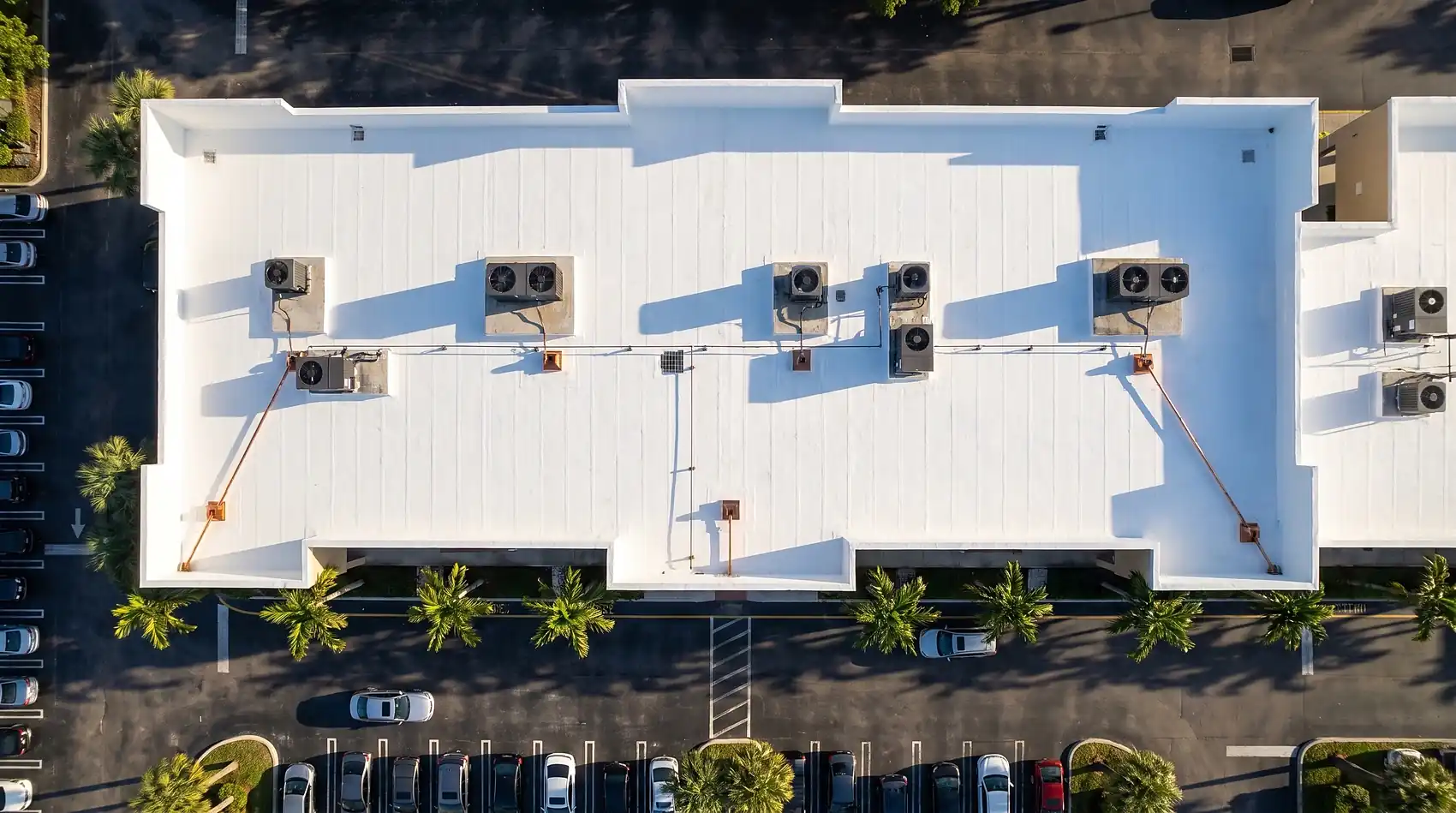
Thermoplastic polyolefin (TPO) is a single-ply membrane, typically white, that is mechanically fastened or fully adhered to the substrate with seams joined by hot-air welding into a continuous sheet.
- Strengths: highly reflective surface (a major cooling advantage in our climate), welded seams that are stronger than the sheet itself when done correctly, good chemical resistance, competitive installed cost, and 20 to 30 years of service life with a quality membrane thickness (60 mil or heavier is worth specifying here).
- Watch-outs: installation quality is everything — seam welding is a skill, and a poorly welded seam is a leak. Thinner membranes are more vulnerable to punctures from rooftop traffic and dropped tools.
- Best for: buildings where cooling cost matters, roofs without heavy foot traffic, and owners who want a long-life system at a mid-range price.
Modified bitumen: the workhorse
Mod-bit is a multi-ply asphalt system reinforced with polyester or fiberglass, applied in overlapping layers — a base sheet and a granulated or reflective cap sheet — by torch, cold adhesive, or self-adhering membranes.
- Strengths: thick, puncture-resistant and forgiving of rooftop traffic; redundancy from multiple plies; long track record; easy to repair with compatible materials.
- Watch-outs: standard granulated caps are darker and absorb more heat than white TPO (reflective cap sheets and coatings address this); torch application requires a fire-safety protocol; seams are lapped rather than welded.
- Best for: roofs with regular maintenance traffic (mechanical equipment, restaurant exhaust), buildings where durability outranks reflectance, and re-roofs over compatible existing systems.
Coatings: restoration, not replacement
A fluid-applied roof coating — silicone or acrylic — is rolled or sprayed over an existing roof to seal it and add a reflective surface. It is a restoration strategy, and it depends entirely on the condition of what is under it.
- Silicone tolerates ponding water and UV extremely well; it is the choice for roofs with drainage issues. It is slippery when wet and harder to recoat with anything but more silicone.
- Acrylic is more economical and easy to apply, but does not tolerate standing water; it belongs on roofs that drain properly.
- When coating works: the substrate is sound, seams and flashings are repaired first, and moisture in the roof assembly has been checked (an infrared or core-sample survey tells you whether wet insulation is trapped below). Coating over a wet or failing roof seals the problem in.
- When it doesn't: widespread membrane failure, saturated insulation, or structural deck issues. Coating those is deferring a replacement at extra cost.
Drainage decides more than material
Every low-slope system lasts longer when water leaves the roof within 48 hours of rain. Clogged drains, missing crickets behind curbs, and low spots from deck deflection cause ponding that shortens the life of any membrane. A commercial roof evaluation should include drainage before it recommends a system.
Working around your operation
Commercial roofing on an occupied building is a logistics job as much as a roofing job. We schedule tear-off and loud work around your operating hours, keep entrances and loading areas clear, protect rooftop equipment, and document daily progress. The owner receives a condition report with photographs and a written scope suitable for capital planning — not just a price.
Frequently asked questions
How long does a TPO roof last in South Florida?
Roughly 20 to 30 years for a quality 60-mil or heavier membrane, properly welded and maintained. Thinner membranes and poor seam work shorten that considerably.
Is a roof coating a good alternative to replacing a commercial roof?
Only when the existing roof is structurally sound, seams and flashings are repaired first, and the insulation is confirmed dry. Coating a wet or failing roof traps the problem.
TPO or modified bitumen — which is better for a restaurant?
Modified bitumen's puncture resistance and tolerance for rooftop traffic usually wins where grease exhaust and frequent HVAC service are involved; a reflective cap sheet or coating recovers some of the energy advantage.
Why is ponding water a problem on a flat roof?
Standing water accelerates membrane breakdown, concentrates weight on the deck, and finds seams and penetrations. Any low-slope roof should drain within about 48 hours of rain.
About the author
Energy Efficient Homes Roofing, LLC is a Florida State-Certified Roofing Contractor (license CCC1337403, verifiable at MyFloridaLicense.com) serving Fort Lauderdale and Broward County. Roof replacement, repair, solar detach and reset, wind mitigation, commercial systems and interior restoration.