
The short answer
A roof leak damages a home from the top down: insulation absorbs water and stops insulating, drywall softens and stains, and framing stays damp long after the surface dries. In South Florida's humidity, mold can begin growing on wet building materials within 24 to 48 hours. Proper interior restoration happens after the roof entry point is repaired and follows a sequence — remove wet insulation and damaged drywall, dry the cavity to verified moisture levels, treat any microbial growth, then replace insulation and drywall and finish.
The roof is fixed. The house is still wet.
Repairing the leak stops new water. It does nothing about the water already inside the ceiling. That water is sitting in insulation that now holds moisture like a sponge, in drywall that has lost its structural paper, and in the wood framing that absorbed it slowly and will release it just as slowly. Interior restoration is the second half of a roof leak repair, and skipping it is how a small leak becomes a mold remediation.
What water does to each material
- Insulation. Fiberglass batts and blown-in insulation lose most of their R-value when wet, and they do not reliably recover when dried in place. Cellulose insulation holds water longer and can support microbial growth. Wet insulation is replaced, not dried.
- Drywall. Gypsum board is paper-faced. Once the paper is saturated, it delaminates and loses strength; the gypsum core crumbles. A stained ceiling that has been wet more than once is usually beyond drying and should be cut out to sound material.
- Framing. Solid lumber tolerates a single wetting well if it is dried promptly and thoroughly. Repeated wetting or slow drying leads to rot and to mold on the surface.
- Electrical. Water in a ceiling cavity reaches junction boxes, recessed lights and wiring. Any wet electrical component needs to be inspected before the cavity is closed.
The 24-to-48-hour reality in South Florida
Mold spores are everywhere; they only need moisture and a food source, and paper-faced drywall and dusty insulation are food. Industry guidance treats 24 to 48 hours of wetness as the threshold for growth to begin. In a Broward attic in summer, with ambient humidity already high, the clock is not generous. That is why "let it dry out for a few weeks" is the wrong plan.
Restoration sequence, done right
- Confirm the roof entry point is repaired. Restoring an interior under an unrepaired roof is wasted money. Our repair documentation shows the source and the fix.
- Assess the extent. A moisture meter and, where useful, a thermal camera map how far the water traveled — which is often further than the visible stain.
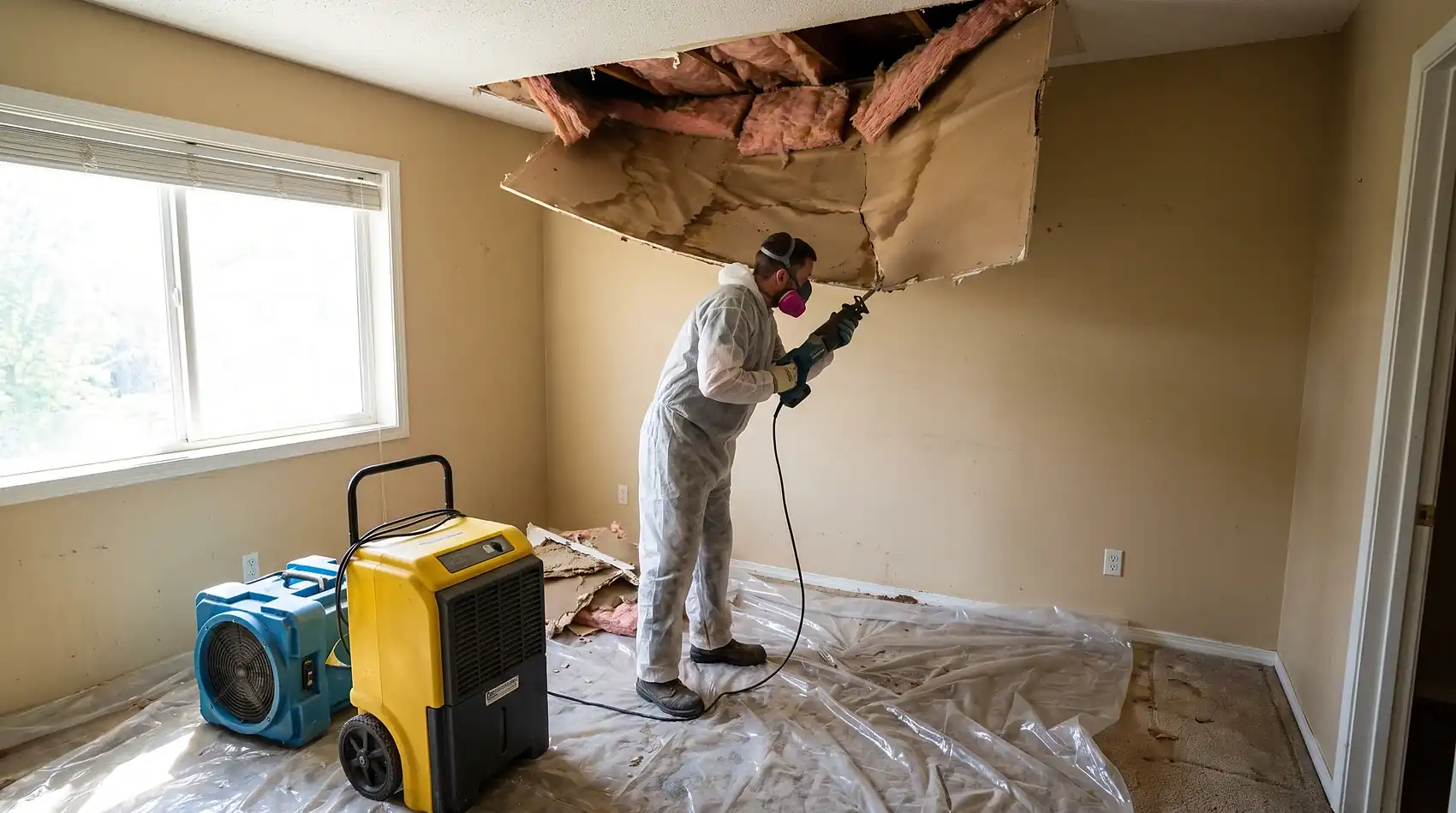
- Remove and contain. Wet insulation is bagged and removed. Damaged drywall is cut back to dry, sound material and to framing for a clean patch. Work is contained to keep dust and any spores out of the living space.
- Dry to a verified level. Air movers and dehumidification bring the cavity and framing to acceptable moisture readings — measured, not guessed.
- Treat if needed. Surface growth on framing is cleaned and treated. Extensive growth is a job for a licensed mold remediator; Florida licenses mold assessors and remediators separately, and we will tell you when the job crosses that line.
- Rebuild. New insulation to the correct depth, new drywall, tape, texture-match and paint. The finished ceiling should be indistinguishable from the rest of the room.
Why we do the interior work too
Most roofers stop at the roof. Most drywall contractors have never looked at a roof. The handoff between them is where things get missed — insulation left wet because nobody checked it, a ceiling patched over framing that was never dried. Handling the roof repair and the interior restoration as one scope, with one contractor accountable for both, closes that gap.
Insurance and documentation
Interior damage from a sudden roof leak is commonly covered under homeowners policies, while damage from long-term neglect commonly is not. The difference is proven with documentation: dated photographs of the roof source, the interior damage, moisture readings and the repair. We produce that record as part of the work so your claim has what it needs.
Frequently asked questions
Can wet attic insulation be dried and reused?
Generally no. Fiberglass loses R-value and cellulose can support microbial growth after wetting. Wet insulation is removed and replaced.
How quickly does mold grow after a roof leak?
Growth can begin within 24 to 48 hours on wet drywall or insulation, and South Florida's humidity does not help. Restoration should begin as soon as the roof source is repaired.
Does homeowners insurance cover ceiling damage from a roof leak?
Sudden, accidental leaks are commonly covered; long-term deterioration commonly is not. Documentation of the cause and the timeline is what separates the two — keep photos and inspection reports.
Do I need a mold remediation company?
For minor surface growth on framing, a restoration contractor can clean and treat it. For extensive growth, Florida requires licensed mold assessment and remediation professionals, and we will tell you when that applies.
About the author
Energy Efficient Homes Roofing, LLC is a Florida State-Certified Roofing Contractor (license CCC1337403, verifiable at MyFloridaLicense.com) serving Fort Lauderdale and Broward County. Roof replacement, repair, solar detach and reset, wind mitigation, commercial systems and interior restoration.