
The short answer
The most reliable early signs of roof trouble in South Florida are ceiling stains that grow after rain, cracked or slipped roof tiles, shingles with lifted edges or heavy granule loss, exposed or rusted flashing around vents and chimneys, daylight visible in the attic, and sagging along the roofline. Any one of these justifies an inspection. Repair is usually the right call when damage is localized and the roof is under roughly two-thirds of its expected life; replacement becomes the better value when problems are widespread or the underlayment has failed.
Why early repair is cheaper than late repair
A roof leak almost never announces itself at the roof. It shows up as a stain on the ceiling weeks after water first got past the covering — and by then it has been soaking decking, insulation and framing the whole time. The repair that would have cost a few hundred dollars at the flashing becomes a decking replacement, an insulation replacement and a drywall job. Catching the signs early is the single biggest lever on cost.
The nine signs
1. Ceiling or wall stains that change after rain
A stain that darkens or spreads after a storm is active water intrusion. A stain that never changes may be an old, already-repaired leak — but it still deserves a look.
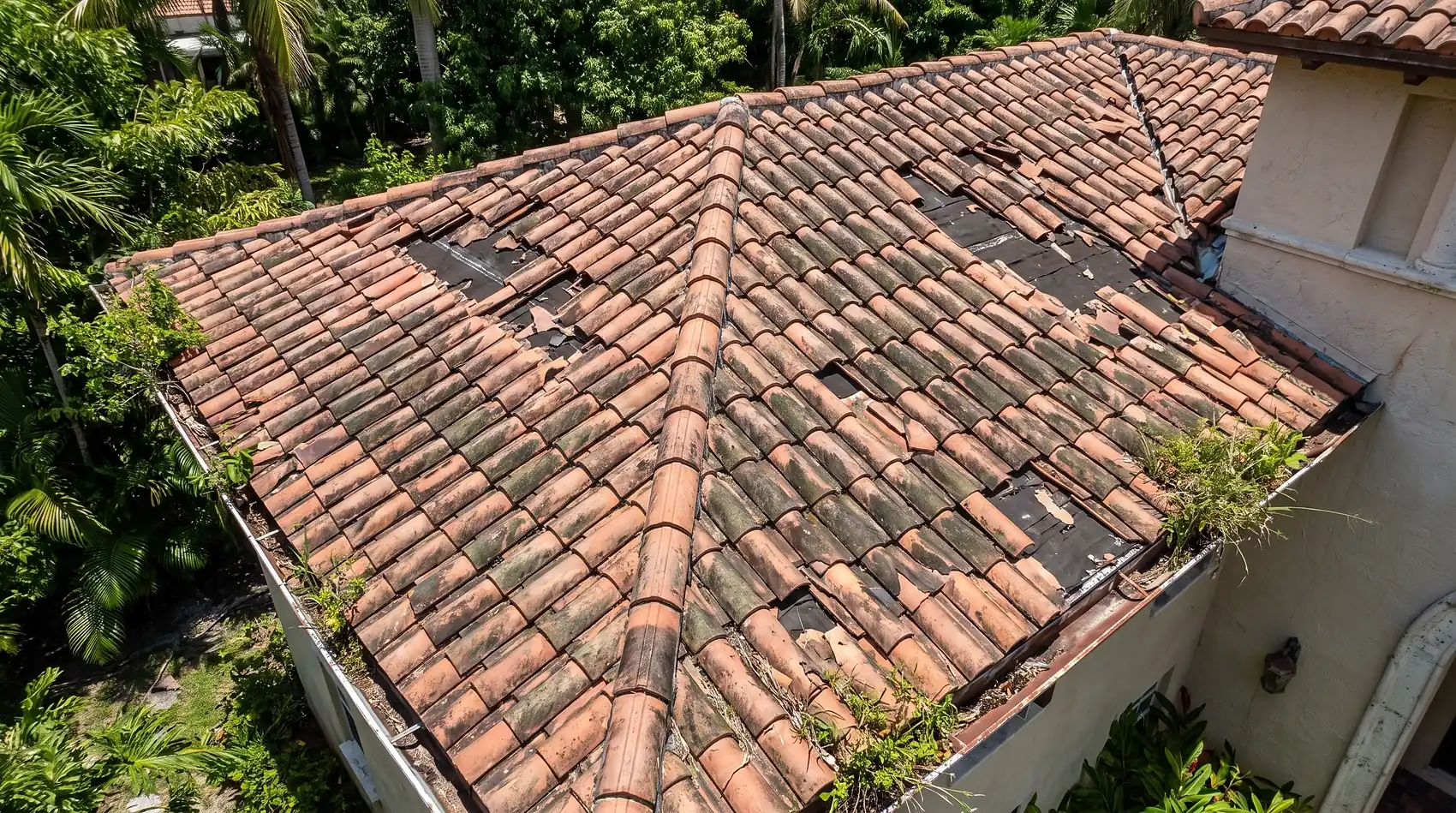
2. Cracked, chipped or slipped tiles
On a tile roof, a broken tile is not itself the leak, because the underlayment beneath it is the waterproofing layer. But a broken tile exposes that underlayment to UV, and UV is what destroys underlayment. Fix it before the layer underneath fails.
3. Lifted or curling shingle edges
In a wind zone, a lifted edge is a wind-catch. The next gust turns one lifted shingle into a dozen missing ones. Lifting also means the sealant strip has failed, which typically happens late in a shingle roof's life.
4. Granules in the gutters
Asphalt shingles shed some granules when new. Heavy, ongoing granule loss — bare patches you can see from the ground — means the shingle has lost its UV protection and is aging fast.
5. Rusted, lifted or missing flashing
Flashing at pipe penetrations, wall intersections, valleys and chimneys is the most common leak source on any roof type. Rubber pipe boots crack in Florida sun within a decade.
6. Daylight in the attic
Turn the lights off in the attic on a bright day. Any pinpoint of light is a hole that water can also use.
7. Sagging or a wavy roofline
This is structural. Sagging usually means decking has softened from long-term moisture. Do not wait on this one.
8. Moss, algae or dark streaking
Common on the north slope in humid South Florida. Algae streaking is mostly cosmetic on shingle; moss holds moisture against the surface and shortens life on any material.
9. A spike in cooling costs
Wet insulation stops insulating. If your summer electric bill jumped and nothing else changed, your attic may be telling you something.
Repair or replace?
Two questions decide it.
- How much of the roof is affected? Localized damage — one valley, one penetration, a section of blown-off shingles — is a repair. Problems across multiple slopes point to a system that has reached the end of its life.
- How old is the roof relative to its expected life? A ten-year-old shingle roof with storm damage is worth repairing. A twenty-two-year-old shingle roof with the same damage is throwing money at a system that will need replacing within a few years anyway.
There is also a code dimension. Florida's rule on repairing more than 25 percent of a roof section within a year can trigger full replacement to current code on older roofs. Our article on the 25 percent rule explains when it applies.
What a proper inspection includes
An inspection that stays on the ground with a pair of binoculars is not an inspection. We walk the roof, check every penetration and flashing detail, enter the attic to look at the underside of the deck for staining and daylight, and photograph what we find. You receive those photos and a plain-language summary — the Roof Report — whether or not you hire us for the work.
Frequently asked questions
How often should a roof be inspected in South Florida?
Once a year and after any named storm. Heat, UV and hurricane season age roofs faster here than in most of the country.
Can a roof leak be fixed without replacing the roof?
Usually, yes — if the roof has meaningful life left and the damage is localized. Most leaks trace to flashing, pipe boots, valleys or a few damaged tiles or shingles, all of which are repairable.
Does a cracked roof tile mean my roof is leaking?
Not immediately. Tile sheds water; the underlayment beneath it is the waterproofing. But a cracked tile exposes underlayment to sun, which degrades it quickly, so cracked tiles should be replaced promptly.
Is a roof inspection free?
Ours is. The Roof Report includes a roof and attic inspection with photos and a written summary at no cost and no obligation.
About the author
Energy Efficient Homes Roofing, LLC is a Florida State-Certified Roofing Contractor (license CCC1337403, verifiable at MyFloridaLicense.com) serving Fort Lauderdale and Broward County. Roof replacement, repair, solar detach and reset, wind mitigation, commercial systems and interior restoration.