
The short answer
A wind mitigation inspection is a standardized Florida inspection (Form OIR-B1-1802) that documents how well your home resists hurricane wind. Florida law (Statute 627.0629) requires insurers to offer premium discounts for the features it scores: roof covering compliance, roof deck attachment, roof-to-wall attachment, roof geometry, secondary water resistance, and opening protection. The inspection is typically valid for five years, and roofing upgrades — especially a new code-compliant covering, improved deck nailing, and a secondary water barrier — are the changes most likely to move your premium.
What a wind mitigation inspection actually is
Florida requires insurers to give homeowners credit for construction features that reduce hurricane losses. The mechanism is a standardized inspection report — the Uniform Mitigation Verification Inspection Form, OIR-B1-1802 — completed by a qualified inspector (a licensed general, building or residential contractor, a licensed architect or engineer, a licensed home inspector, or other professionals the statute allows). You submit the completed form to your insurer, and the insurer applies the discounts its filed rates provide.
The report is generally accepted for five years. If you replace your roof during that window, a new inspection can capture the improvement immediately.
The seven things it scores
- Building code. Was the home built (or the roof permitted) under the Florida Building Code of 2001 or later, or in the HVHZ, the South Florida Building Code of 1994 or later? Broward County homes fall under the HVHZ line.
- Roof covering. Was the roof covering installed under a permit with FBC-compliant or Miami-Dade-approved products? A new roof from a licensed contractor with a closed permit usually satisfies this. An old roof with no permit record usually does not.
- Roof deck attachment. How is the plywood or plank deck nailed to the trusses? The best category is 8d nails (2.5 inches) spaced 6 inches on center along both the edges and the interior of each sheet. Older homes with 6d nails or wide spacing score lower. This can only be upgraded during a re-roof, when the deck is exposed.
- Roof-to-wall attachment. How are the trusses connected to the walls? Toe-nails are the weakest; metal clips are better; single wraps and double wraps (straps that go over the truss) are best. This is inspected from the attic.
- Roof geometry. A hip roof (slopes on all four sides) earns credit when hip features make up at least 90 percent of the roof perimeter. Gable roofs score lower because gable ends catch wind.
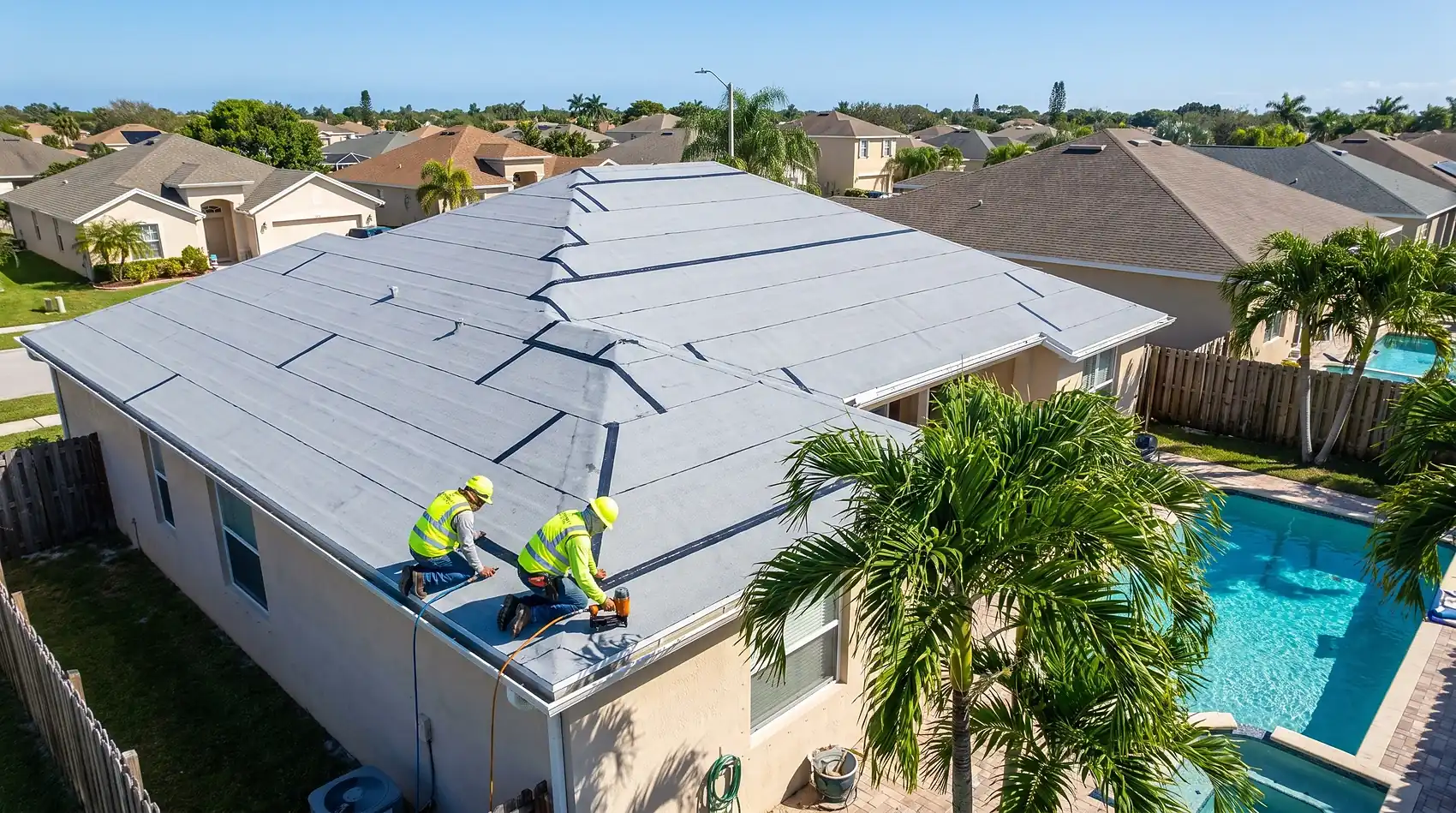
- Secondary water resistance (SWR). A self-adhering modified bitumen underlayment or a sealed-deck system applied directly to the decking, so that if the covering blows off, the deck still sheds water. This is one of the most cost-effective upgrades and can only be installed during a re-roof.
- Opening protection. Impact-rated windows, doors and shutters. Not a roofing item, but it is on the same form.
The upgrades a re-roof makes possible
Three of the seven categories are physically impossible to improve without removing the roof covering: deck attachment, secondary water resistance, and the roof covering credit itself. That is why we tell homeowners planning a replacement to think of wind mitigation as part of the project, not a separate one.
During a replacement in the HVHZ, current code already requires a strong deck attachment schedule and an approved underlayment system. The additional step is making sure the work is documented in a way an inspector can verify: permit closed, product approvals on file, photographs of the deck nailing before underlayment goes on. We photograph the deck on every job for exactly this reason.
What the discount is worth
The honest answer: it depends on your insurer, your policy, your home's construction and which features you qualify for. Discounts are set in each insurer's filed rates, not by the contractor. In our experience, homeowners who go from an older roof with no documentation to a new, documented, code-compliant roof with SWR often see a meaningful change — but the number is your insurer's to give. Get the inspection, submit the form, and ask your agent to show you the credits applied line by line.
A note on timing
If you already have a valid wind mitigation report and then replace your roof, do not assume the insurer will pick up the change. A new inspection after the roof is complete is the way to capture the credit.
Frequently asked questions
How much does a wind mitigation inspection save on insurance?
It varies by insurer and by which features your home has. Florida law requires insurers to offer discounts for the scored features, but the amounts are set in each company's filed rates. Ask your agent for a line-by-line credit breakdown.
How long is a wind mitigation inspection good for?
Typically five years. A new inspection after a roof replacement can capture the upgrade sooner.
Can a roofer do my wind mitigation inspection?
The form must be completed by a qualified inspector as defined in Florida law — commonly a licensed home inspector, contractor, architect or engineer. Your roofer's job is to build and document the roof so the inspection scores well.
What is secondary water resistance?
A self-adhered underlayment or sealed-deck system bonded directly to the roof deck so the deck sheds water even if the covering is lost in a storm. It is one of the most cost-effective wind mitigation upgrades and can only be installed during a re-roof.
About the author
Energy Efficient Homes Roofing, LLC is a Florida State-Certified Roofing Contractor (license CCC1337403, verifiable at MyFloridaLicense.com) serving Fort Lauderdale and Broward County. Roof replacement, repair, solar detach and reset, wind mitigation, commercial systems and interior restoration.